Fuller Law Firm
408-234-7563
79 Devine Street, Suite 100, San Jose, CA 95110
 408-234-7563


Blog
408-234-7563
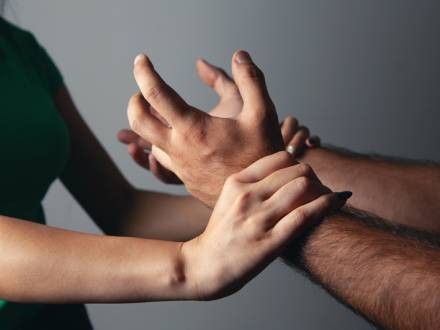
In California, domestic violence cases can become much harder to untangle when both partners are arrested and each blames the other. Each person can face serious criminal charges that affect their relationship, family, and future—even if one says they acted in self-defense.
If you’re facing charges in 2026, our San Jose, CA domestic violence defense lawyer can help you understand your rights. More importantly, we’ll discuss the defenses that apply to your case.
Under Cal. Penal Code § 13701, every law enforcement agency must develop written policies for domestic violence response. Those policies have to discourage dual arrests when appropriate.
Officers must try to figure out who was most responsible for the violence. California law calls this person the "dominant aggressor," and it is not always the person who acted first.
Officers must consider several factors when deciding who was the main aggressor. These include past domestic violence, threats of physical harm, and whether either person acted in self-defense. Officers must also consider the need to protect victims from further abuse.
The person who called for help or expressed fear is not necessarily the victim or the aggressor. Officers must consider all the evidence when making that decision.
Imagine officers arrive at a chaotic scene with two upset people giving conflicting accounts. Often both people have injuries. Sorting out what happened can be difficult, but officers still need to look at the evidence before deciding whom to arrest. Police can arrest both partners if they have probable cause to believe each committed a crime. However, conflicting accounts alone do not justify arresting both people.
Visible injuries can influence arrest decisions, but they do not always tell the whole story. A person acting in self-defense can leave scratches or marks on the other person. Being calm or upset when officers arrive does not prove who was responsible for the violence.
Language barriers, intoxication, and a history officers cannot access in the moment all contribute to dual arrests in these cases. After an arrest, prosecutors decide whether to file charges against one partner, both partners, or neither.
Two arrests from one incident can create problems that neither case would have alone. Each person may become a witness in the other’s case. That can create a problem. Statements either person makes while defending themselves could also be used against them in their own case. A person explaining what their partner did is also describing their own conduct.
Protective orders may be issued against one or both partners. If the orders prohibit contact, neither person can contact the other. If you share a home, children, a vehicle, or a business, those arrangements have to run through the court rather than through a conversation.
Each person also has a Fifth Amendment right not to testify in their own case. They can also refuse to answer questions in their partner’s case if the answers could expose them to criminal charges. That can make it harder for prosecutors to prove either case.
The two cases may also be handled by different prosecutors and different judges, moving on separate schedules.
If both partners are arrested for domestic violence, a defense attorney can review the evidence to determine what happened and whether the charges are justified.
Possible defenses include:
Self-defense: You used reasonable force to protect yourself from immediate harm.
Incorrect identification of the aggressor: Police wrongly concluded that you were responsible for the violence.
False accusations: Your partner made false or misleading statements about the incident.
Lack of evidence: The prosecution doesn’t have enough evidence to prove the charges.
Accidental contact: Any physical contact was unintentional rather than an act of violence.
An attorney can review injuries, witness statements, 911 recordings, body camera footage, and messages between the partners. This evidence can help establish what happened and support your defense.
Born and raised in Santa Clara County, Attorney Cory Lee Fuller attended Bellarmine and Santa Clara University. He chose to stay local and serve the community he grew up in. At Fuller Law Firm, we believe every client and their family deserves someone to give them a voice in the justice system. Every case is different, but most families just want a way to get their lives back on track.
Contact Fuller Law Firm at 408-234-7563 to talk to our San Jose, CA domestic violence defense lawyer today.
408-234-7563From our office in San Jose, California, we serve clients throughout the Bay Area, including but not limited to Campbell, Los Gatos, Cupertino, Santa Clara, Sunnyvale, Gilroy, Morgan Hill, Los Altos, Palo Alto, Saratoga, Milpitas, Mountain View, Fremont, Stanford, Union City, and Santa Clara County.


 The use of the Internet or this form for communication with the firm or any individual member of the firm does not establish an attorney-client relationship. Confidential or time-sensitive information should not be sent through this form.
I have read and understand the Disclaimer and Privacy Policy.